
 Tiếng Việt

In the technical process of installing concealed gypsum ceiling systems, besides the standard requirements for leveling and height alignment that most installers are already familiar with and perform correctly, there remain two structural installation issues that many workers still find confusing and difficult to execute.
These difficulties often lead to labor shortages and higher ceiling installation costs at certain project sites. The two main issues are as follows:
 – Align ceiling frames to avoid interference with lighting fixtures and MEP (Mechanical, Electrical, and Plumbing) systems.
– Complete frame installation and inspection before boarding:
In this article, we will help installers better understand the technical aspects of these two key points.
Requirements for Aligning Frames to Avoid Lighting Fixtures and MEP Systems:
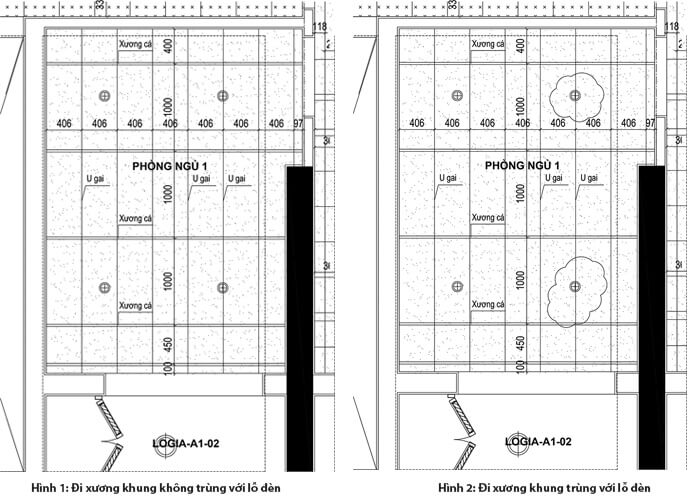
To properly align the ceiling frame and avoid lighting fixtures or MEP equipment, installation teams must first review the MEP layout drawings. Then, prepare a detailed.
ceiling framing plan to ensure all main and cross channels are positioned clear of any equipment.
The main advantage of this approach is that when cutting holes for lights later, the framing system will remain intact—maintaining structural strength, flatness, and ceiling aesthetics. However, due to tight spaces, this process may increase material use and labor costs.
Lighting Interference Can Be Avoided in Two Ways:
- Shift the entire ceiling frame layout so that the overlap spacing remains outside the lighting fixture area (as shown in Figure 1).
- Install the frame from left to right; if an obstacle such as a light or MEP device is encountered, adjust the spacing and alignment to avoid it.
With the requirement to install the framing first, inspect, and fix the boards later:
This requirement ensures that it is easy to check the type, spacing, height, and number of ceiling frames before boarding. All critical positions must be reinforced before the boards are fixed. This method provides a more stable ceiling structure and prevents sagging or deformation over time.
However, the downside is that it extends the installation time, as all frames must be fully installed before the boards can be fixed. Workers cannot hide incomplete framing, and alignment adjustments must be made carefully to meet the required standards before boarding.
We hope that the above information will help installers easily resolve the two key technical challenges in the concealed gypsum ceiling installation process, achieving both high-quality and aesthetically pleasing results.